
neurosciencestuff:
How LSD can make us lose our sense of self
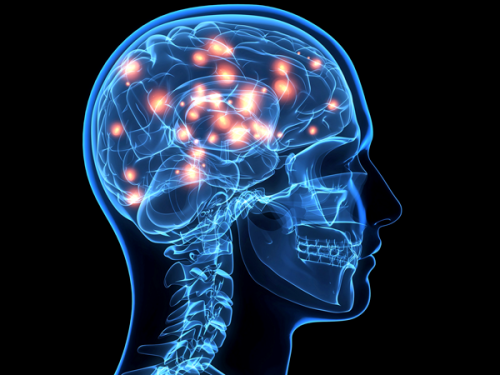
When people take the psychedelic drug LSD, they sometimes feel as though the boundary that separates them from the rest of the world has dissolved. Now, the first functional magnetic resonance images (fMRI) of people’s brains while on LSD help to explain this phenomenon known as “ego dissolution.”
As researchers report in the Cell Press journal Current Biology on April 13, these images suggest that ego dissolution occurs as regions of the brain involved in higher cognition become heavily over-connected. The findings suggest that studies of LSD and other psychedelic drugs can produce important insights into the brain. They can also provide intriguing biological insight into philosophical questions about the very nature of reality, the researchers say.
“There is ‘objective reality’ and then there is ‘our reality,’” says Enzo Tagliazucchi of the Royal Netherlands Academy of Arts and Sciences in Amsterdam. “Psychedelic drugs can distort our reality and result in perceptual illusions. But the reality we experience during ordinary wakefulness is also, to a large extent, an illusion.”
Take vision, for example: “We know that the brain fills in visual information when suddenly missing, that veins in front of the retina are filtered out and not perceived, and that the brain stabilizes our visual perception in spite of constant eye movements. So when we take psychedelics we are, it could be said, replacing one illusion by another illusion. This might be difficult to grasp, but our study shows that the sense of self or 'ego’ could also be part of this illusion.”
It has long been known that psychedelic drugs have the capacity to reduce or even eliminate a person’s sense of self, leading to a fully conscious experience, Tagliazucchi explains. This state, which is fully reversible in those taking psychedelics, is also known to occur in certain psychiatric and neurological disorders.
But no one had ever looked to see how LSD changes brain function. To find out in the new study, Tagliazucchi and colleagues, including Robin Carhart-Harris of Imperial College London, scanned the brains of 15 healthy people while they were on LSD versus a placebo.
The researchers found increased global connectivity in many higher-level regions of the brain in people under the influence of the drug. Those brain regions showing increased global connectivity overlapped significantly with parts of the brain where the receptors known to respond to LSD are found.
LSD also increased brain connectivity by inflating the level of communication between normally distinct brain networks, they report. In addition, the increase in global connectivity observed in each individual’s brain under LSD correlated with the degree to which the person in question reported a sense of ego dissolution.
Tagliazucchi notes in particular that they found increased global connectivity of the fronto-parietal cortex, a brain region associated with self-consciousness. In particular, they observed increased connection between this portion of the brain and sensory areas, which are in charge of receiving information about the world around us and conveying it for further processing to other brain areas.
“This could mean that LSD results in a stronger sharing of information between regions, enforcing a stronger link between our sense of self and the sense of the environment and potentially diluting the boundaries of our individuality,” Tagliazucchi said.
They also observed changes in the functioning of a part of the brain earlier linked to “out-of-body” experiences, in which people feel as though they’ve left their bodies. “I like to think that our experiment represents a pharmacological analogue of these findings,” he says.
Tagliazucchi says the findings highlight the value of psychedelic drugs in carefully controlled research settings. He plans to continue to use neuroimaging to explore various states of consciousness, including sleep, anesthesia, and coma. He also hopes to make direct comparisons between people in a dream versus a psychedelic state. Meanwhile, researchers at the Imperial College London are investigating other psychedelic drugs and their potential use in the treatment of disorders including depression and anxiety.


 "Drunk at the matinee" is a collection of candid poetry about stupid shit that we all experience from day to day.







No comments:
Post a Comment